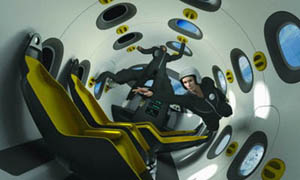
Astrium's stunning space jet concept

June 2007

Forget about being blasted off from a spaceport or dropped from a mother ship.

Imagine a private spacecraft that can take off from a conventional runway, blast into space and then land just like a normal plane.

That's the promise from French space company Astrium which has unveiled a revolutionary space jet at a special VIP event in Paris ahead of the Le Bourget Airshow.

Guests at the Paris event were shown a full sized mock-up of the forward section of the revolutionary four-passenger, rocket-equipped jet which blasts space tourists to an altitude of 60 miles (100 kilometers) in minutes.

French vision a simple one

Astrium's vision of sending paying passengers into space on board conventional-style jet aircraft is one that many people can relate to.

Not everyone wants to be kitted out and sat at the top of an explosive rocket or dropped from the underbelly of a "mother ship", which is what is on offer at present for space tourists.

The French like things simple and climbing aboard a jet aircraft - as though you were jetting off to London - is the Holy Grail of space travel for most people.

The Astrium space jet will take off and land conventionally from a standard airport using its jet engines. However, once the craft is airborne at an altitude of about 12 kilometers, the rocket engines will be ignited to give sufficient acceleration to reach 100 km.

In just 80 seconds the craft will have climbed to a 60 km altitude.

Innovative seats balance themselves to minimize the effects of acceleration and deceleration, ensuring passenger comfort and safety.

The rocket propulsion system is then shut down as the ship’s inertia carries it on to above 100 km, where the four paying passengers will experience zero gravity in space.

Once in space, passengers can unbuckle their seatbelts and experience about three minutes of weightlessness.The pilot will control the craft using small rocket thrusters to make this experience more enjoyable.

They'll be free to float around the cabin of the plane and gaze through any of the jet's 15 windows and glimpse a spectacular view of the Earth.

Then, it's time to go home.

After slowing down during descent, the jet engines are restarted for a normal and safe landing at a standard airfield.

The entire trip will last approximately an hour and a half.

Safe and economical
Astrium is proposing the one stage system as it is considered the safest and most economical to operate.

If development begins in 2008, the first commercial flight could be possible by 2012.

And the cost? About 200, 000 Euros ($US268,000), says Astrium. Passengers will need to train for about a week.

The company says the development of a new vehicle able to operate in altitudes between aircraft (20km) and below satellites (200 km) could well be a precursor for rapid transport ‘point-to-point’ vehicles or quick access to Space - opening up previously unexplored territory.

It says its development will contribute to maintaining (and even enhancing) European competences in core technologies of Space Transportation.

As the single industrial prime contractor for Ariane 5, the main European contributor to the International Space Station and as a wholly owned subsidiary of EADS, Astrium has the necessary expertise and know-how for manned space flight.

Financing
As it is a commercial project, private capital will be the main source of funding. The financial envelope, which will be around one billion euros, could be completed by refundable loans and by regional development funding.

Return on investment will come from operations of vehicles for the emerging and promising market of suborbital space tourism.

Astrium passengers experiencing zero gravity
Passengers on board the space jet will experience three minutes of zero gravity.